
GPT-6 Astra's Price Tag — and How Architecture Keeps It Off Your SME Bill
GPT-6 Astra is being reported at roughly $10 in / $50 out per million tokens with a ~1M-token context window — flagship-grade money. Here is the honest math on why that bill is set by your architecture, not the model, and how to keep it affordable.
A few days ago we walked through what OpenAI’s new flagship, GPT-6 Astra, can actually do — the SOTA computer-use numbers, the cybersecurity results, the “most aligned” pitch. This is the follow-up that usually decides whether you build with it or wait: what does it cost, and can a small business actually afford to run it at volume?
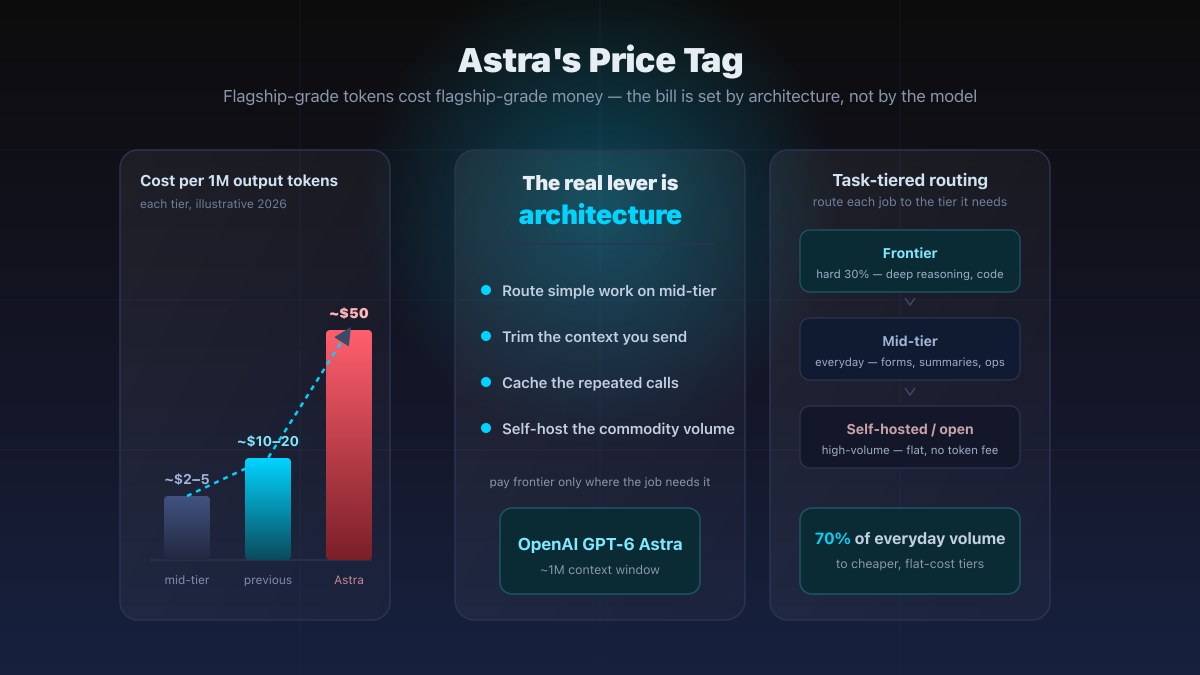
The short answer: at launch, Astra is unquestionably one of the priciest frontier models on the market. If you point your entire workload at it, the token bill will be the least pleasant number in your P&L. But the model is not the cost problem — how you route work across models is. The same Astra-powered feature can run at roughly five times the bill, or about half, depending almost entirely on the architecture around it.
This article lays out the real pricing (provider by provider), compares Astra to its predecessors and to the rest of the frontier, does the SME math honestly, and shows the architecture patterns that keep a flagship model affordable.
What we actually know about Astra’s price
Let’s be clear about sourcing, because model pricing moves fast and not everything below is official.
- Pricing — Astra is being reported at around $10 in / $50 out per million tokens. That’s a launch-window figure from third-party trackers, not yet a confirmed OpenAI list price on a generally-available API.
- Context window — a ~1M-token context window is also reported. Very large, and one of the reasons a single call can carry a lot of context (which, as you’ll see, is both a feature and a cost trap).
- Availability — already listed on OpenRouter, so it’s reachable through one key alongside other models; that matters for cost and lock-in (more below).
- Rollout — per CNBC, OpenAI is releasing access in stages: first to a limited set of trusted organizations, including its application-based Daybreak cybersecurity program (approved defenders), then to ChatGPT tiers (Plus, Pro, Business, Enterprise), with the API and cloud availability following. Cyber-sensitive, aggressive capabilities are gated behind that trusted access. Forbes questions how much of the early rollout is confirmed versus announced.
Provider by provider: where you can actually get Astra
The model’s price is one number; what you actually pay depends on which route you take to it.
OpenAI API (direct). The canonical source. Launch reporting puts it around $10 / $50 per M tokens — confirm the live rate on OpenAI’s platform pricing page. The trade-off is concentration: you’re locked to one provider’s pricing, one availability schedule, and one data-handling policy — which is exactly the lock-in risk that bites when a rival model is 30% cheaper for your workload.
OpenRouter (aggregator). Astra is already listed here. OpenRouter sits in front of many models behind a single key, so you can swap models or providers without rewriting code, and its pricing tracks list price with a small spread. For a small team, that optionality is worth a lot — it’s the cheapest way to stay vendor-neutral while you figure out which model earns its keep.
AWS. Astra is also landing on AWS as part of the rollout3. If you’re already running on AWS, that means the model can stay inside your existing VPC, billing, and access controls — no second stack to wire up. Same as everywhere else: once it’s generally available, confirm the live per-token rate on the provider’s page.
Where Astra sits on the cost curve
Pricing a model by output per million tokens is the number that matters for most workloads, because generation is where you spend. Here’s the rough shape of the frontier, as of launch (illustrative class positions; Astra’s ~$50 is the reported figure):
Read that chart as a warning: Astra is priced a clear step above the previous flagship tier, and an order of magnitude above the mid-tier. That gap is only affordable if you’re careful about what gets to touch Astra.
Astra vs its predecessors
The capability jump from GPT-5.6 “Sol” to Astra is real — higher accuracy and roughly 47% faster on computer-use tasks (covered in the launch piece). But the price moved in the same direction. You’re not just buying a slightly better model; you’re buying the top shelf, at top-shelf money.
Two practical consequences:
- The bar for “is this worth Astra” is higher than it was for Sol. A task you’d have happily run on the previous flagship may not clear its own cost at Astra’s price. The default answer flips from “use the flagship” to “use the flagship for the 30% that needs it.”
- The 1M context is a cost multiplier if you’re lazy about it. A huge window tempts you to stuff the whole codebase, every document, and three years of chat history into one call. Every one of those tokens is billed. Big context is a feature until you stop trimming it — then it’s a line item.
Astra vs the rest of the frontier
Here’s how Astra stacks up against the other flagships, on the dimensions that drive an SME’s bill rather than a leaderboard. Pricing classes are representative and must be confirmed on official pages.
| Model | Known for | Price class | Self-host · Lock-in |
|---|---|---|---|
| OpenAI — GPT-6 Astra | Computer use, browsing, coding, security (~1M context) | Top of market (~$10 / $50) | No · high |
| Anthropic — Claude (Opus 4.5) | Long-context coding, tool use | Flagship class | No · high |
| Google — Gemini (3.x) | Multimodal, very long context, Workspace | Lower input tier | Partial · medium |
| Open-weights (DeepSeek, etc.) | Near-flagship, low price | No token fee | Yes · none |
Two things jump out. First, none of the frontier APIs are cheap at flagship tier — the differentiation for a small business is access, speed on your workload, and price — not which model is the smartest. Second, the only way out of the per-token meter entirely is self-hosting an open-weights model, which is a real and increasingly practical option (our AI & LLM integration service covers self-hosting options).
The honest version of “which is best” is the same one every engineer eventually arrives at: pick the model that’s best at your task, that you can afford, and that you can integrate this quarter — then benchmark it on your own workloads. The leaderboard tells you where tier one is; your own numbers tell you where you should spend.
The SME problem: flagship prices, small-business volumes
This is where the altitude of the whole thing lands. Let’s do the math, honestly, with assumed volumes so you can see the mechanism (your real numbers will differ — the point is the shape).
Assume a feature — an AI support/ops assistant — that moves 100 million tokens a month, split 50M input / 50M output.
- Everything on Astra (~$10 in / $50 out):
50M × $10 + 50M × $50 = $500 + $2,500 ≈ $3,000 / month
Now apply the two levers that actually matter — route the commodity work to a cheaper tier, and cache what repeats:
- Tiered routing (70% of volume to a mid-tier at ~$2 / $10; 30% that genuinely needs Astra):
commodity 35M: $70 + $350 = $420·Astra 15M: $150 + $750 = $900·≈ $1,320 / month
Now add the third lever — self-host the 70% commodity tier (no token fee, flat infra):
- Tiered + self-hosted commodity (self-hosted ~$300 flat; Astra 30M unchanged):
≈ $1,200 / month — and it stays near-flat as volume grows
Source: Illustrative, using launch-reported Astra pricing (~$10/$50) and representative mid-tier pricing, 2026
That’s roughly a two-to-three-fold reduction on the same feature, with none of it coming from a cheaper model — all of it from architecture. And the self-hosted version has a property the other two don’t: its cost stops scaling with usage, which is the single most important thing for a small business that can’t predict next quarter’s traffic.
The architecture that keeps a flagship affordable
None of this is exotic. It’s a handful of patterns, in the order they pay off.
1. Task-tiered routing. Classify each request and send it to the tier that actually needs. Form-filling, extraction, classification, summarization, and “is this a question or a ticket?” are all commodity work — a mid-tier model does them fine at a fraction of the price. Astra earns its keep on the hard 30%: complex reasoning, non-trivial code, multi-step agent work, and anything that touches a real system.
2. Trim and cache the context. The 1M window is an invitation to over-stuff. Trim prompts to what the task needs, and put prompt caching on the static 40%+ of context you send on every call (system prompts, your product docs, templates). Caching can cut the input side dramatically, and the input side is where a big context quietly becomes a bill.
3. Self-host the commodity tier. For the high-volume, low-stakes 70%, an open-weights model on your own infrastructure removes the per-token meter entirely. You trade a token bill for a flat, predictable infra cost — and your data never leaves your network to a third party’s meter. This is where “self-hosted LLM” stops being a buzzword and becomes a line item that flattens.
4. Stay vendor-neutral. Front everything with an aggregator or a thin abstraction layer so “model X is 30% cheaper for this job” is a config change, not a rewrite. Lock-in is a silent cost — it quietly taxes every future price negotiation.
5. Make the bill visible. Wire in per-feature token metering and budget alerts. The teams that get burned are the ones who find out about the spike on the invoice, not in a dashboard. If you can’t see where the tokens go, you can’t tier them.
6. Start with a cost audit. Before you buy, measure what your current prompts actually cost and what share of calls genuinely need a frontier model. That one afternoon of measurement tells you the real tiering split — and it’s usually the difference between a $3,000 habit and a $1,200 one.
What this means for a small business
Astra is a genuine capability leap, and for a handful of tasks it’s worth the premium. But the default for a small business should not be “put everything on the new flagship.” It should be:
- Benchmark first. Take your real tasks, run them on your current model and on Astra, and let your own numbers decide the split. Don’t guess the tier.
- Route, don’t standardize. Design for multiple tiers from day one, not a single model.
- Watch the rollout. If you need it now, a paid ChatGPT tier is the fastest door; the API (where most production automation actually lives) follows in the phased rollout.
- Price the self-hosted option for the commodity volume before you assume a per-token bill is unavoidable.
The flagships race hard, and the gaps between them are not “smart enough or not.” The gaps that matter to you are access, speed on your workload, price, and how well the model fits what you already run. So “pick the #1 model” is the wrong decision. “Pick the one that’s best at my task, that I can afford, and that I can integrate this quarter” is the right one.
Bottom line
Astra is better than anything that came before it — and it’s priced like it. For a small business doing meaningful volume, that combination means the bill is almost never about the model and almost always about the architecture.
Route the commodity work down, cache the repeated context, self-host the high-volume low-stakes tier, stay vendor-neutral, and make the spend visible. Do that and the same flagship-powered feature runs for a fraction of the naive price — and, critically, a cost that flattens as you grow instead of multiplying with every new user.
If you’re already running automation or agents, the most useful next step is to benchmark the stack you have — what it can and can’t do. Once you know, you’ll know whether Astra is a genuine bargain for you, or just looks impressive.
External references
- CNBC — OpenAI launches GPT-6 “Astra” — launch coverage, Daybreak rollout and the phased access model (Sep 3, 2026).
- Forbes — OpenAI announces GPT-6 Astra, or does it? — independent take on the rollout and skepticism around early reporting (Sep 3, 2026).
- OpenRouter — GPT-6 Astra — live aggregator listing with current per-token pricing.
- OpenAI — GPT-6 Astra: A new generation of intelligence — the first-party launch post behind the capability numbers.
- OpenAI — Platform pricing — confirm the official per-token rates once the API is generally available.
Related articles
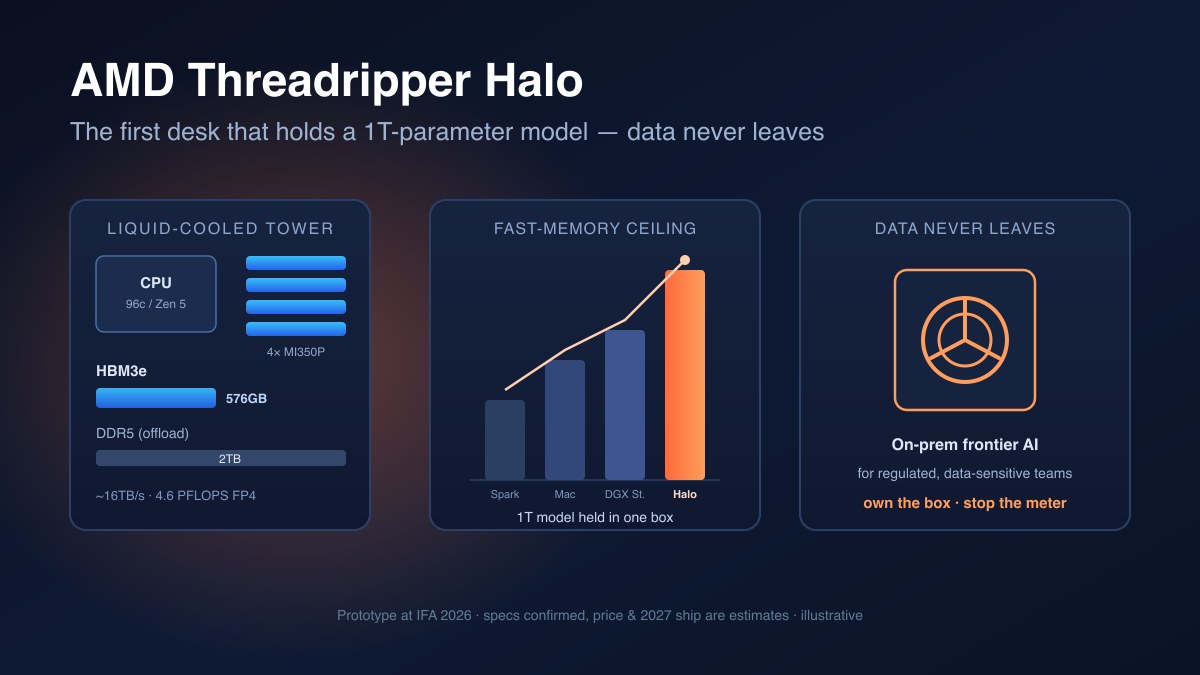
AMD's Threadripper Halo: On-Prem Frontier AI for When Your Data Can't Leave the Building
AMD's Threadripper Halo pairs a 96-core CPU with up to 576GB of HBM3e — the first deskside box that can hold a trillion-parameter model without a datacenter. Here's what that memory actually buys, what it costs, and who should seriously consider it.
Read article →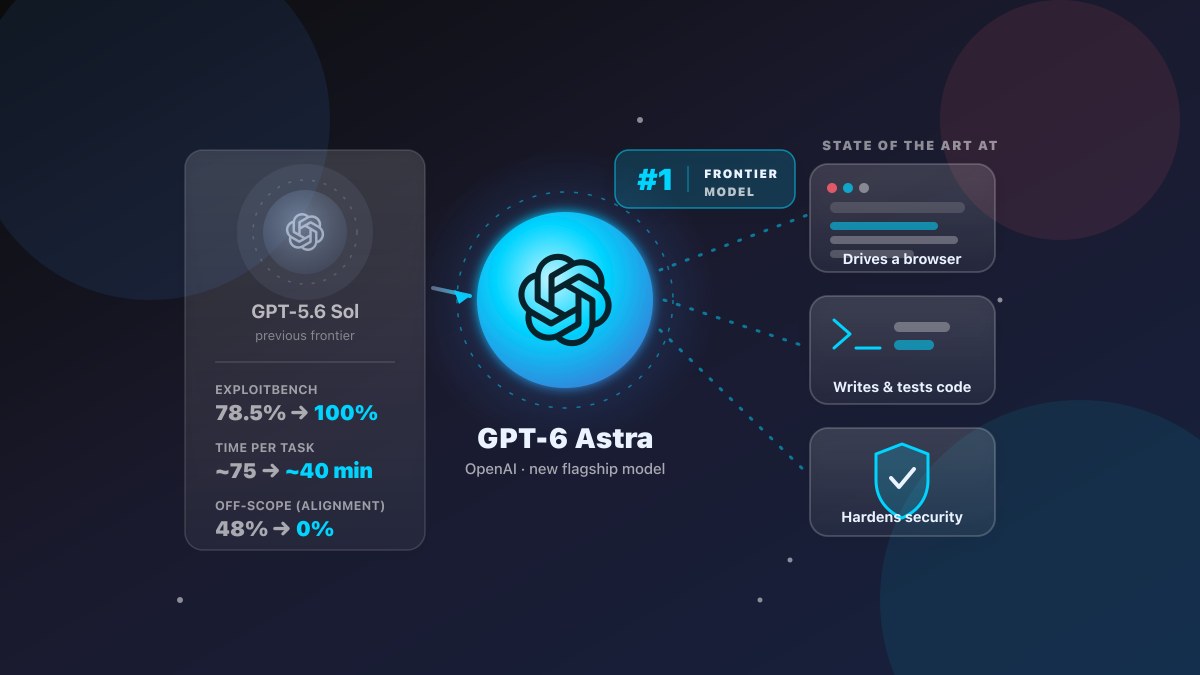
OpenAI's GPT-6 Astra Just Moved the Goalposts — Here's What It Means for Your Business
OpenAI's new flagship GPT-6 Astra claims state-of-the-art computer use, coding, and cybersecurity — 99.9% on ARC-AGI-3, 98% on FrontierMath Tier 4, 100% on ExploitBench, and ~47% faster at driving a computer. What the numbers actually mean for a small business, the honest trade-offs, and when you can use it.
Read article →
Passkeys in 2026: Your Customers Already Use Them — Does Your Website Let Them In?
FIDO's 2026 report: 5 billion passkeys in use, 90% consumer awareness, and 47% of people more likely to abandon a purchase over a forgotten password. What a passkey actually is, what it costs to add, and when it's worth it for your business.
Read article →