
AMD's Threadripper Halo: On-Prem Frontier AI for When Your Data Can't Leave the Building
AMD's Threadripper Halo pairs a 96-core CPU with up to 576GB of HBM3e — the first deskside box that can hold a trillion-parameter model without a datacenter. Here's what that memory actually buys, what it costs, and who should seriously consider it.
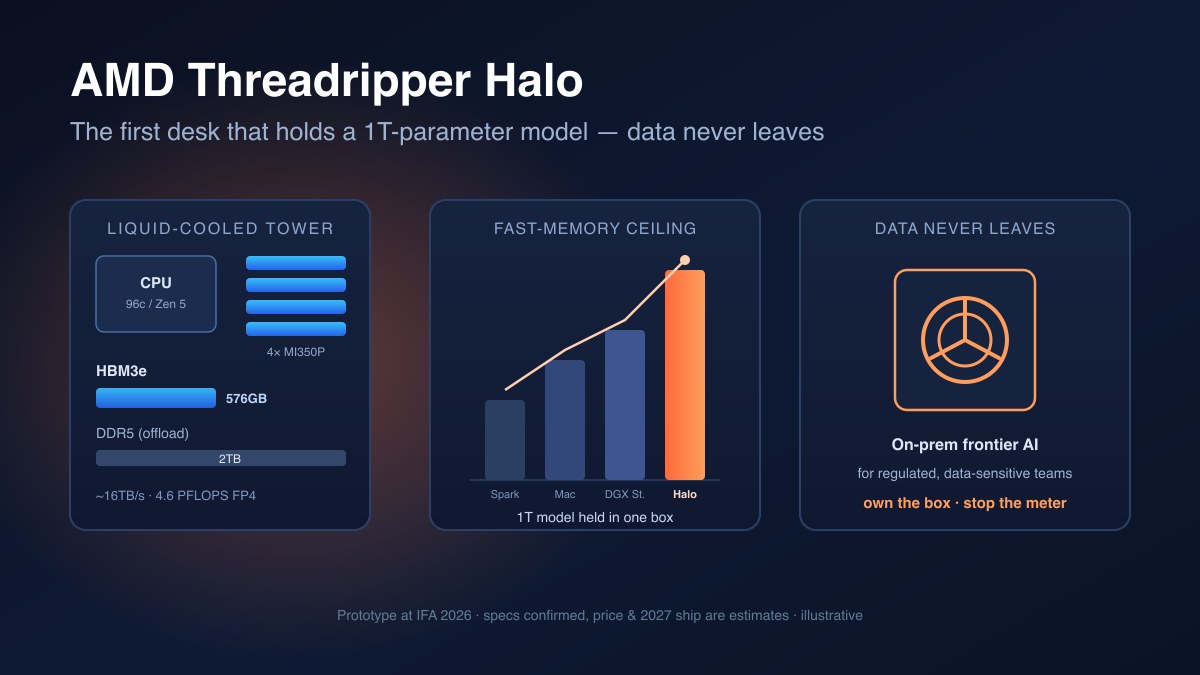
Most “local AI” boxes fail at the same wall: the model is too big to fit in fast memory. The machine computes just fine — it just can’t hold the weights, so it spills them to slow memory and stalls. AMD’s new Threadripper Halo Station is an attempt to demolish that wall for real. Shown at IFA 2026 in Berlin, it’s a liquid-cooled deskside workstation pairing a 96-core Threadripper CPU with up to four datacenter Instinct accelerators — 576GB of HBM3e high-bandwidth memory in total. That’s enough to keep a model with more than a trillion parameters resident on a single box: no cloud, no cluster, no network hop.
This is not a consumer product, and it won’t be one for a while. AMD is calling it a prototype — there’s no price and no ship date, and analysts put a finished system in the six figures with a realistic window of 2027. But it matters more than the spec sheet suggests, because it changes who can run frontier-scale models at all: any organization whose data legally, contractually, or competitively can’t leave the building.
This article separates what’s confirmed from what’s estimated, shows which real open-weight models actually fit in that memory, compares the box to the alternatives (and to renting the same compute), and is honest about the one thing the marketing won’t lead with: this is a capacity claim, not a speed claim.
What’s confirmed, and what’s still a guess
Model and hardware pricing moves fast, so let’s separate the lock-down facts from the third-party math before anything else.
- The CPU — a Threadripper PRO 9995WX, 96 cores / 192 threads on the Zen 5 architecture, 128 lanes of PCIe 5.0. That lane count is the reason four full-bandwidth accelerators can hang off one socket without starving each other.
- The accelerators — Instinct MI350P cards, 144GB of HBM3e at 4TB/s each. Two are in the base configuration; ServeTheHome confirms a hardware path to four, which is what gets you to 576GB.
- The system memory — up to 2TB of DDR5 alongside the accelerator memory, for offloading the tail of a model that doesn’t quite fit in HBM.
- The price — not published by AMD. Every dollar figure you’ll see (including ours) is a parts-based estimate from the press, not an AMD quote.
The box, spec by spec
The CPU is the supporting act. The headline is memory attached to datacenter GPUs — the same Instinct line AMD sells into hyperscale clusters, packaged behind a power cord.
| Component | Specification |
|---|---|
| CPU | Threadripper PRO 9995WX — 96 cores / 192 threads, Zen 5, 128× PCIe 5.0 |
| Accelerators | AMD Instinct MI350P — 2 base, path to 4 |
| Accelerator memory | 144GB HBM3e / 4TB/s per card → 288GB base, 576GB max |
| System memory | up to 2TB DDR5 (8-channel) |
| Combined memory bandwidth | ~16TB/s (4× 4TB/s) |
| Peak compute | ~4.6 PFLOPS FP4 (4-card config) |
| Cooling | Full liquid cooling (CPU + accelerators) |
| Status | Prototype — no price, no ship date |
“Trillion parameters” — a capacity claim, not a speed claim
Here’s the part the keynote framing glosses over, and the part that matters most if you’re deciding whether to plan around this.
“Can run a trillion-parameter model” is an arithmetic-of-space statement. At roughly 4-bit precision, parameters cost about half a byte each, so a 1-trillion-parameter model is around 550GB of weights. That fits in the 576GB of HBM3e — just — and the 2TB of DDR5 is there to absorb any spillover. The weights fit. That’s the real, defensible achievement.
What the claim is not saying is that it will serve a trillion-parameter model at useful speed. Frontier models at that scale are normally spread across a cluster of interconnected accelerators for a reason: throughput. A single tower holding a 1T model is a genuinely useful research and experimentation machine — you can run it, inspect it, fine-tune it, run private inference on it. It is not, today, a drop-in replacement for a serving cluster. Expect it to be usable for building, not for production traffic.
Which real open-weight models actually fit
The useful way to think about the 576GB of HBM3e plus 2TB of DDR5 is two tiers: what fits in HBM (fast) and what needs DDR5 offload (functional, but slower). Footprints below are weights-only, at a representative quantization.
| Open-weight model | Params (active) | Approx. footprint | Where it runs |
|---|---|---|---|
| Llama 4 Maverick (MoE) | 400B (17B active) | ~420GB (Q8) | in HBM — fast |
| GLM-4.5 (MoE) | 355B (32B active) | ~373GB (Q8) | in HBM — fast |
| DeepSeek V4-Flash (MoE) | 284B (13B active) | ~298GB (Q8) | in HBM — fast |
| Qwen3-235B (MoE) | 235B (22B active) | ~247GB (Q8) | in HBM — fast |
| DeepSeek V3 (MoE) | 671B (37B active) | ~369GB (Q4) | in HBM (Q4) |
| DeepSeek V4-Pro (MoE) | 1.6T (49B active) | ~880GB (Q4) | DDR5 offload — research-grade |
The “active” number is the point of a Mixture-of-Experts design: a 400B model that only runs 17B of weights per token gives you frontier-class quality at a fraction of the per-token cost — which is exactly why these are the models worth holding on-prem. Note that Qwen3-Max is not open-weight (it’s API-only), so it’s not in this table — the open frontier here is DeepSeek, Llama 4, GLM, and Qwen3’s open 235B.
Where it sits, against the alternatives
The Halo is not competing on price or accessibility. It’s competing on ceiling — nobody else is publicly marketing a deskside machine that holds a trillion-parameter model in memory without splitting it across a network. Here’s the field, on the dimensions that drive a real decision:
| Machine | Fast memory | Stack | ~Price |
|---|---|---|---|
| Threadripper Halo | up to 576GB HBM3e (+2TB DDR5) | ROCm | ~$100–150K (est.) |
| Nvidia DGX Station | 252GB HBM3e (+496GB) | CUDA | ~$100K |
| Nvidia DGX Spark | 128GB unified | CUDA | ~$4K |
| Apple Mac Studio (M5 Ultra) | 512GB unified | MLX / Metal | consumer |
Against the direct rival, the Nvidia DGX Station (72-core Grace + B300, 252GB of HBM3e), AMD’s numbers hold up: roughly 3.4× the total memory and more than double the memory bandwidth. But the DGX Station’s edge is the CUDA stack — cuDNN, TensorRT, and the sheer volume of existing research code written against it — which is still where most serious AI pipelines are built.
The DGX Spark (128GB unified) and the M5 Ultra Mac Studio (up to 512GB) live in a different category entirely: affordable local AI for mid-size models and development, not trillion-parameter research. The Spark can run inference on models up to ~200B on its own (up to ~700B with four units linked); the Mac Studio is the default hobbyist box for open models at a consumer price. Neither is pitched at the Halo’s ceiling.
The real alternative, though, isn’t a rival box — it’s not buying one at all and renting the compute by the hour.
Owning it vs renting it: the honest math
A six-figure workstation only makes sense against the cost of renting the same capability. Live third-party cloud listings (RunPod, as of mid-2026) put a single top-tier GPU at roughly:
- H100 — ~$3.49/hr
- H200 — ~$4.59/hr
- B200 — ~$6.79/hr
- B300 — ~$7.89/hr
Run that continuously (24/7) and the break-even question becomes “how many years of rented GPU time does a ~$150K box buy?”
Read that the same way we read a cost curve: a six-figure box is two years of top-tier GPU time, or close to five years of a common H100 — and after that, nothing leaves your network and nothing accrues per token. If you’re running continuous, always-on inference and the data is sensitive, that math tilts hard toward owning. If you’re doing bursty, spiky, experimental work, renting wins, because you pay only for the hours you use.
The honest line: a $150K machine buys about two years of top-tier cloud GPU, then the bill stops. For a team doing steady on-prem inference on sensitive data, that’s the whole case. For everyone else, the rental meter is still cheaper.
The ROCm question (and why inference is where it’s won)
The elephant in the room for any AMD accelerator is ROCm — AMD’s answer to CUDA. For a long time the gap was real and it’s why most researchers default to Nvidia regardless of spec.
Two things have shifted, and both matter for a local-inference buyer specifically. First, ROCm 10.0 (released in 2026) ships production-ready support for vLLM and SGLang, the two runtimes that matter for serving large models locally, with validated containers and wheels. Second — and this is the key one — inference is where ROCm parity with CUDA is closest. The gap that still lingers is in custom training kernels and the breadth of the surrounding library ecosystem. A workstation whose whole job is to run an open-weight model locally is precisely the workload where that gap is smallest.
Who should actually buy this (and who shouldn’t)
Be honest with yourself about the buyer pool, because it’s narrower than the headlines imply.
This is for you if:
- Your data can’t leave the building — regulated industries (health, finance, defense-adjacent), client-confidential workloads, IP you won’t send to a third-party API.
- You need full-weight access — inspection, interpretability, custom kernels — where a hosted API is structurally the wrong tool.
- You run continuous, always-on inference and the multi-year rental cost has crossed your threshold.
- You need the model resident and available without a cloud account at all.
This is probably not for you if:
- You’re an individual developer or a small team doing bursty work — the DGX Spark or a high-memory Mac Studio is a fraction of the cost and covers mid-size models.
- Your workload is standard training/fine-tuning you could run in the cloud — the ROCm ecosystem is still the weak point there.
- You want it this quarter — this is a 2027 box, and the two-card and four-card configurations aren’t even confirmed SKUs yet.
The realistic early adopters are research labs and enterprises with dedicated hardware budgets and a data-governance mandate — not the broad AI market. AMD built a halo product in the literal sense: a machine designed to signal that the local frontier is real, as much as one designed to move volume.
What it means for a data-sensitive business
If you’re the kind of business that uses AI but can’t ship your data to a third-party endpoint, this machine is the first credible single-box answer — and it’s a signal worth paying attention to even if you don’t buy one.
- The local ceiling is rising fast. The binding constraint on local AI has been memory capacity, not compute — and this box raises that ceiling by an order of magnitude over anything else you can put on a desk. A workload that required a cloud endpoint in 2025 may be a local workload in 2027 at a fraction of this box’s price.
- Plan the self-hosted path now, buy later. You don’t need the Halo to start thinking about where your data lives. The architecture — which models, which stay on-prem, which can go to an API, how you keep it vendor-neutral — is the same whether the box costs $4K or $150K.
- Match the tier to the sensitivity. Not every model needs $150K. A mid-size open model on a $4K box handles a lot; the trillion-parameter box is for the data that genuinely can’t move.
Bottom line
The Threadripper Halo is the first deskside machine with a real claim to frontier-scale local inference — a trillion-parameter model held in memory on one box, with the data never leaving the room. It’s a prototype, it’s expensive by any honest estimate, and it ships in 2027.
But the capability it points at is the one that matters for data-sensitive work: a model you own, running on a box you own, with a bill that stops instead of accruing per token. For the businesses where that’s the constraint, the decision isn’t “buy the Halo” — it’s “start designing the on-prem path for the data you can’t move.” That’s a decision you can make this quarter, well before the box is available.
If you’re running AI and your data has a governance reason to stay in-house, the most useful next step is a straightforward question: which of your workloads could live on-prem, and what would it cost to make that real? We’ll design that path with you — the model tiering, the self-hosting, the vendor-neutrality — so the day a box like this lands, you’re ready for it.
External references
- The Register — AMD’s Threadripper Halo is a local-AI workstation for researchers with deep pockets — launch coverage, headline specs, 576GB / 16TB/s framing (Sep 4, 2026).
- ServeTheHome — AMD Announces Threadripper Halo Station — spec breakdown, the two-to-four MI350P path, and DGX Station comparison.
- TechPowerUp — AMD Introduces Threadripper Halo Station at IFA 2026 — IFA keynote coverage.
- Nvidia — DGX Spark — official 128GB / 200B-inference spec.
- Apple — Mac Studio specs — M5 Ultra 512GB unified memory.
- RunPod — pricing — live per-hour cloud GPU listings used for the ownership-vs-rental math.
- AMD — ROCm 10.0 release — production-ready vLLM / SGLang support.
Related articles
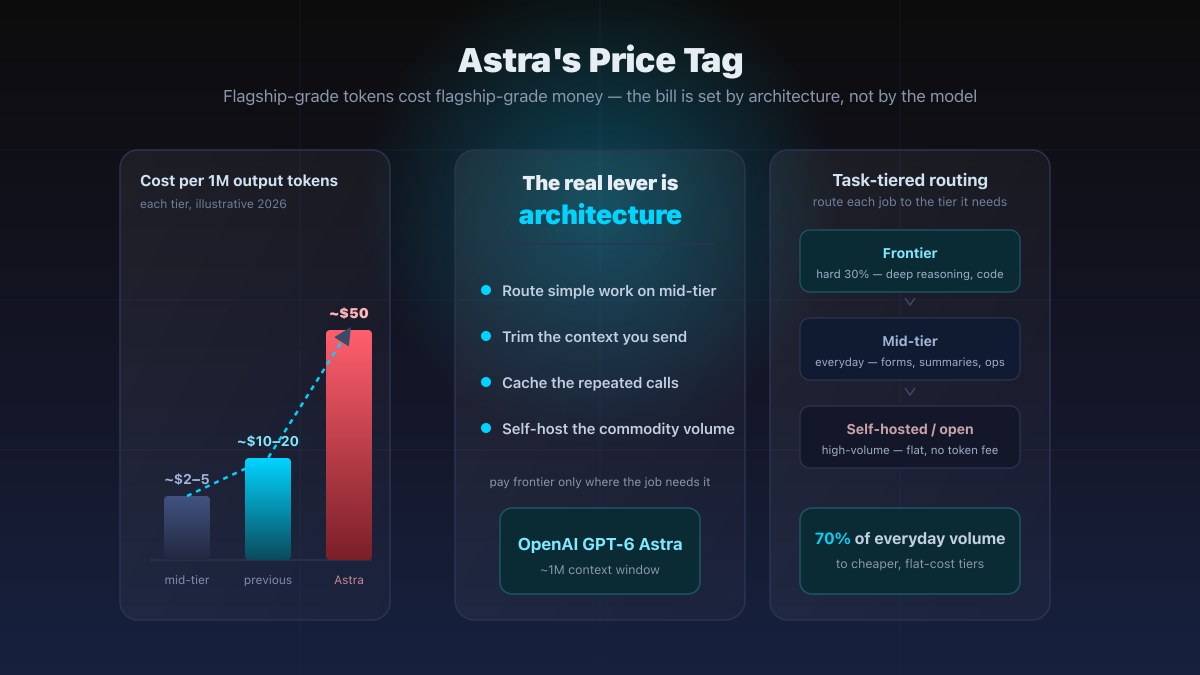
GPT-6 Astra's Price Tag — and How Architecture Keeps It Off Your SME Bill
GPT-6 Astra is being reported at roughly $10 in / $50 out per million tokens with a ~1M-token context window — flagship-grade money. Here is the honest math on why that bill is set by your architecture, not the model, and how to keep it affordable.
Read article →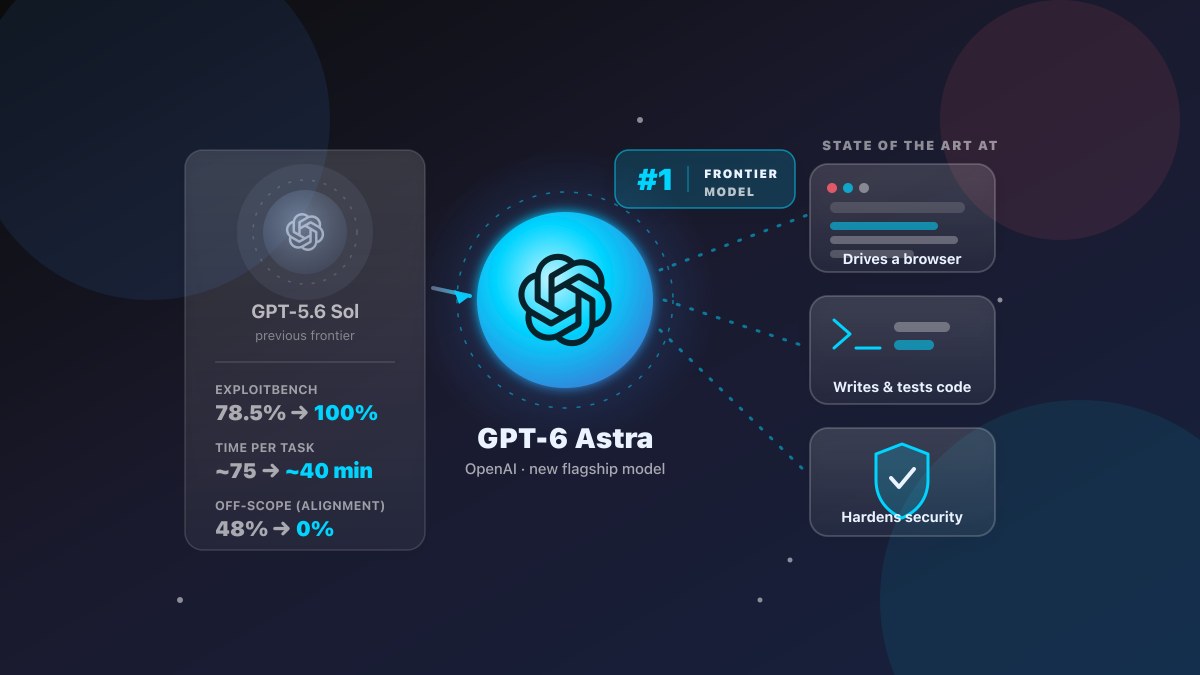
OpenAI's GPT-6 Astra Just Moved the Goalposts — Here's What It Means for Your Business
OpenAI's new flagship GPT-6 Astra claims state-of-the-art computer use, coding, and cybersecurity — 99.9% on ARC-AGI-3, 98% on FrontierMath Tier 4, 100% on ExploitBench, and ~47% faster at driving a computer. What the numbers actually mean for a small business, the honest trade-offs, and when you can use it.
Read article →
Passkeys in 2026: Your Customers Already Use Them — Does Your Website Let Them In?
FIDO's 2026 report: 5 billion passkeys in use, 90% consumer awareness, and 47% of people more likely to abandon a purchase over a forgotten password. What a passkey actually is, what it costs to add, and when it's worth it for your business.
Read article →